
Classic Dominoes: Dominos Game
Big CakeBoard
4.9859.00 Reviews
- Version
- 1.0.46
- Installs
- 5.00M
- Age Rating
- Everyone
Screenshots





Our Review of Classic Dominoes: Dominos Game
 Analysis by Appyee
I spent time with Classic Dominoes: Dominos Game as a straightforward board game for Android, and its appeal is easy to understand: it lets me sit down for a short dominoes session without needing a table, a second physical set, or a complicated setup. It is free to download, made by Big Cake, and aimed at Everyone, so it is positioned as an accessible choice rather than a niche strategy title. The central question is not whether dominoes works on a phone—it does—but whether this particular presentation gives you enough reason to keep it installed.
My answer is mostly positive for casual players. The game is best when I want a quiet break, a familiar ruleset, or something that can fill a few spare minutes away from an internet-heavy multiplayer experience. It is less convincing for someone looking for deep competitive systems, a large social community, or a highly customized tabletop simulation. That distinction matters because the game’s strength is its simplicity, not an ambitious collection of extras.
How the free model affects the experience
The download is free, which makes trying it low-risk. The game includes in-app purchases ranging from $1.99 to $59.99 per item, so “free” should be understood as free access rather than a promise that every optional purchase has the same value. I would start without spending anything and judge the basic experience first. For a board game built around placing tiles, that is a sensible approach: the core question is whether the rounds feel comfortable and enjoyable before any optional transaction becomes relevant.
I appreciate that the price does not create a barrier for a family member or friend who simply wants to test a digital dominoes game. A free entry point is especially useful here because dominoes is familiar enough that many people already know whether they enjoy the format. You do not have to commit to a paid app just to discover that you prefer another style of play.
At the same time, I would not treat the most expensive purchase as automatically good value. The listed range tells me that optional spending can become significant, but it does not by itself establish that a purchase is necessary for a satisfying session. My practical advice is to use the free experience as the baseline, avoid buying impulsively, and only consider an optional item if it solves a specific annoyance or adds something you genuinely want to use repeatedly.
That approach also keeps the game’s value easy to judge. If you only need a few relaxed rounds now and then, free access may be enough. If you expect a premium, feature-rich board-game platform, you should compare what you actually receive before treating an in-app purchase as an upgrade rather than a convenience.
What the game is trying to do
Classic Dominoes: Dominos Game belongs to the board category, and its identity is refreshingly clear. It is not trying to turn dominoes into a role-playing adventure or bury the board beneath a complicated progression system. I open it for the familiar ritual of drawing or receiving tiles, looking for a legal placement, and deciding whether to play immediately or hold a useful option for later.
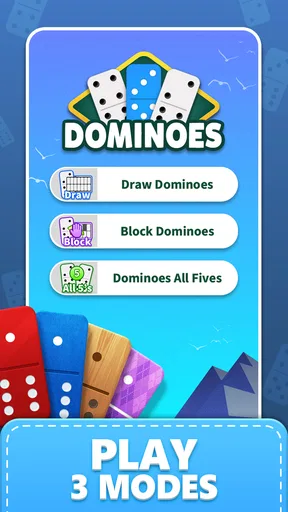
The store summary points to three ways to play, and that variety is important because a single dominoes format can become repetitive quickly. Different modes can change the rhythm of a session: one may suit a quick, low-pressure break, while another may make me think more carefully about the remaining tiles and the opponent’s likely options. I found that switching modes is more valuable than simply playing longer in one format.
The game’s offline positioning is also meaningful. A board game that can be used away from a connection fits situations where online matchmaking would be inconvenient or unreliable. I can imagine using it during a commute with poor reception, while waiting for an appointment, or at home when I want to put my phone on a simpler, quieter task. Offline play also removes the pressure of finding another person at the exact moment I feel like playing.
That does not make it a substitute for every kind of dominoes. If your favorite part is talking with friends across a table, reading a real opponent’s expressions, or joining a live online room, a solo offline-focused experience will naturally feel limited. The useful comparison is not “digital versus physical” in the abstract; it is whether you want dependable personal practice or a social event.
Small decisions make the simple format worthwhile
The first non-obvious strength is that dominoes rewards attention even when the interface looks uncomplicated. I learned not to play the first legal tile automatically. A move can be legal and still be poor if it leaves me with awkward ends, closes off a useful number, or gives the opponent an easy continuation. The phone format makes quick play tempting, so I deliberately pause before confirming a move.
My second tip is to watch the board rather than only my own hand. When one end of the layout remains open, the available number becomes strategically important. If I repeatedly see an opponent avoid a particular number, I treat that as a clue rather than assuming the move was random. This is where the app becomes more than a tile-matching distraction: it can be a compact exercise in memory, probability, and restraint.
A third useful habit is to change modes when my attention drops. Dominoes can feel repetitive if I continue playing while mentally elsewhere, but a different mode can make the same basic tile set feel more deliberate. I would use the quicker style for a short break and reserve the more thoughtful option for a longer session. That simple rotation helps the free game last longer without requiring purchases.
I also found value in using it as a practice tool before playing physical dominoes. A phone cannot reproduce every house rule or table convention, but it lets me rehearse basic tile awareness without setting up a full game. If I am rusty, a few rounds help me remember to count possibilities, protect flexible tiles, and avoid wasting a strong move simply because it is available now.
Where the presentation may frustrate you
The same simplicity that makes the game approachable can become a limitation. Players who want detailed statistics, a long-term competitive ladder, extensive customization, or a strong social layer may find the experience too modest. I would not install it expecting the depth of a dedicated tournament platform. Its value comes from immediate play, not from building a large identity around every match.
There is also a trade-off in offline convenience. Playing alone means I can start whenever I want, but it also means the game cannot recreate the unpredictability and personality of a human sitting across from me. An automated opponent can provide a useful challenge, yet it will not replace the negotiation, humor, or tension of a real group. For family gatherings, I would still choose physical dominoes if the goal were shared conversation.
Another point to consider is spending discipline. Because the game is free to begin, I would not assume that every optional purchase improves the fundamentals. The listed purchase range is broad, and the sensible value calculation depends on whether you want convenience or simply more rounds of the basic game. A person who is happy with the free experience may have no reason to pay; someone irritated by a limitation should first decide whether that limitation is central enough to justify spending.
Device compatibility is reasonably broad for an older Android handset, since the game requires Android 6.0 or later. That makes it a practical candidate for phones that are not running the newest software. Still, compatibility is not the same as identical comfort on every screen. Dominoes benefits from clear tile visibility, so I would check that the board feels readable on your particular phone before settling into long sessions.
The current version is 1.0.44, which gives the app a specific point of reference when I evaluate it. I would keep it updated through the normal app channel, especially if I rely on it for offline use. Updates can affect stability or presentation, and a board game is most enjoyable when the controls respond predictably rather than making me fight the interface.
Who will get the most from it?
This is a strong fit for someone who already likes dominoes and wants a private, low-pressure way to play. It also works for newcomers because the basic idea is easy to recognize: match and place tiles while planning around the open ends. The Everyone rating supports its broad audience, although younger players may still benefit from an adult explaining strategy rather than expecting the app alone to teach every subtlety.
I would recommend it to commuters, casual puzzle players, and people who enjoy familiar board games but do not want a large download full of unrelated systems. It is also useful for anyone who wants a quiet alternative to scrolling. Instead of consuming short videos during a waiting period, I can play a round that asks me to remember information and make a small decision every turn.
It is less suitable for players who need constant novelty. If you quickly tire of repeating a traditional ruleset, the presence of several modes may not be enough to keep you interested indefinitely. Likewise, competitive players who measure enjoyment through rankings, live opponents, detailed records, or organized events should look toward a more specialized multiplayer option.
The audience response suggests that the game has found a broad casual audience: it carries a 4.9 average from around 67 thousand ratings and has passed 5 million installs. Those figures do not guarantee that it will suit every player, but they do make the app worth considering when you want a widely tried dominoes option rather than an obscure experiment. I would still use my own playing habits as the deciding factor, because popularity cannot turn a quiet solo game into a social one.
How it compares with the usual alternatives
Against physical dominoes, the app wins on setup and portability. There is no need to find a flat surface, sort a box of tiles, or persuade another person to join immediately. It loses on tactile satisfaction and shared presence. I would choose the app for practice or a solitary break, and the physical set for a family evening where the conversation matters as much as the score.
Against online dominoes games, its offline focus is the defining advantage. A live service can offer human unpredictability and social energy, but it may also require a connection, an account, or patience while another player becomes available. This game is better when reliability and privacy matter more than competition. If you want to test yourself against people from around the world, the usual online alternative is likely the better fit.
Against larger board-game collections, this title is narrower but easier to understand. A multi-game app may offer more variety for the same installation, yet it can also bring clutter and make it harder to get directly to the activity you want. Here, the narrow focus is a benefit when dominoes is specifically what I feel like playing. It becomes a weakness only when I expect one app to replace an entire shelf of games.
That comparison helped me define its proper role. I would not call it the definitive dominoes experience for every audience. I would call it a convenient digital table for quick, familiar sessions, especially when being offline is more useful than being connected.
My buying decision after regular use
After using it as a casual board game, I see the best value in the free starting experience. It gives a dominoes fan an easy way to play without a financial commitment, and the three modes help prevent the app from feeling like a single repeated routine. The developer, Big Cake, has kept the concept focused enough that I can launch it with a clear expectation instead of learning a complicated ecosystem.
My main caution is to keep expectations realistic. This is not the right choice if you want a rich social competition, extensive long-term progression, or the atmosphere of a real table. It is also not automatically worth a high optional purchase simply because the download costs nothing. The free version should earn your attention first, and any spending should be based on a feature or convenience you will actually use.
For me, the deciding advantage is practical: I can turn a few empty minutes into a small strategic exercise, even when I am offline. I like that it rewards patience rather than frantic tapping, and I find the familiar board easier to return to than a more elaborate game. The limitations are real, but they are mostly limitations of scope rather than signs that the basic idea is confused.
My verdict: try it free if you want simple offline dominoes, and skip it if social competition is your main reason to play. As a focused board game for Android, it delivers a comfortable, accessible way to practice tile decisions and relax. I would recommend keeping it installed for occasional sessions, while treating the in-app purchases as optional rather than essential. With an Everyone rating, Android 6.0 support, and a clear focus on classic play, it is an easy recommendation for casual players who value convenience over spectacle.
Privacy and Permissions
See what permissions an app requests and how it handles your data.
- Device & app history
- retrieve running apps
- Photos/Media/Files
- read the contents of your USB storage, modify or delete the contents of your USB storage
- Storage
- read the contents of your USB storage, modify or delete the contents of your USB storage
- Wi-Fi connection information
- view Wi-Fi connections
- Other
- view network connections, full network access, control vibration, prevent device from sleeping, Google Play license check
Verdict
Strengths of Classic Dominoes: Dominos Game
- Simple rules make it easy for beginners to start playing.
- Several game modes provide variety for different play styles.
- Short matches work well for quick gaming sessions.
- Clean visuals keep the board easy to read on small screens.
- Offline play is useful when you have no internet connection.
Limitations of Classic Dominoes: Dominos Game
- Limited strategic depth may disappoint experienced dominoes players.
- Ads can interrupt gameplay, especially between completed rounds.
- Online features may depend on an active and stable connection.
- Replay value can feel repetitive after extended sessions.
- Some options and customization features may be restricted or basic.
Other Releases by Big Cake
View All


Similar Picks in This Category
View All
Ludo King®
Gametion4.1

Ludo
Yarsa Games4.6

Tile Master® - Matching Game
Higgs Studio3.6

Checkers Online
CC Games4.6

Dominoes
Loop Games4.7

Chess
Chess Prince4.6
Frequently Asked Questions
What is Classic Dominoes: Dominos Game?
Classic Dominoes: Dominos Game is a digital version of the traditional dominoes board game for mobile devices. It generally lets you play familiar modes such as Draw Dominoes, Block Dominoes, or All Fives, depending on the available version. The app is designed for quick matches, simple touch controls, and casual play, making it suitable for both beginners learning the rules and experienced players wanting a convenient game on Android or iOS.
Can beginners easily learn how to play Classic Dominoes: Dominos Game?
Yes. The game is relatively easy to understand because its main objective is the same as in physical dominoes: match tiles with the same number of dots and be the first player to use all your pieces, or achieve the best score according to the selected mode. New players should still review the instructions, since scoring, drawing rules, and available game variations can differ between modes.
Does Classic Dominoes: Dominos Game work offline?
Many dominoes apps are designed to support offline matches against computer-controlled opponents, which is useful when traveling or when you do not have a stable internet connection. However, specific features such as online multiplayer, leaderboards, advertisements, cloud synchronization, or certain events may require connectivity. Before downloading, check the app-store description and test the game with mobile data and Wi-Fi disabled.
Can I play against other people or only against the computer?
Classic Dominoes: Dominos Game may offer both solo matches against artificial-intelligence opponents and multiplayer options, depending on the version and platform. Computer matches are convenient for practicing strategies, while online modes can provide a more competitive experience. Multiplayer availability, private rooms, matchmaking, and account requirements may vary, so confirm these details in the current store listing before installing.
Is Classic Dominoes: Dominos Game free to download, and does it contain ads or purchases?
The game may be available as a free download, but free access commonly includes advertising, optional in-app purchases, or premium features. Ads can appear between rounds, on menus, or after completing a match, while purchases may remove advertising or unlock additional themes and options. Review the pricing information, permissions, and in-app purchase section on Google Play or the App Store before downloading.
Play our best games!


